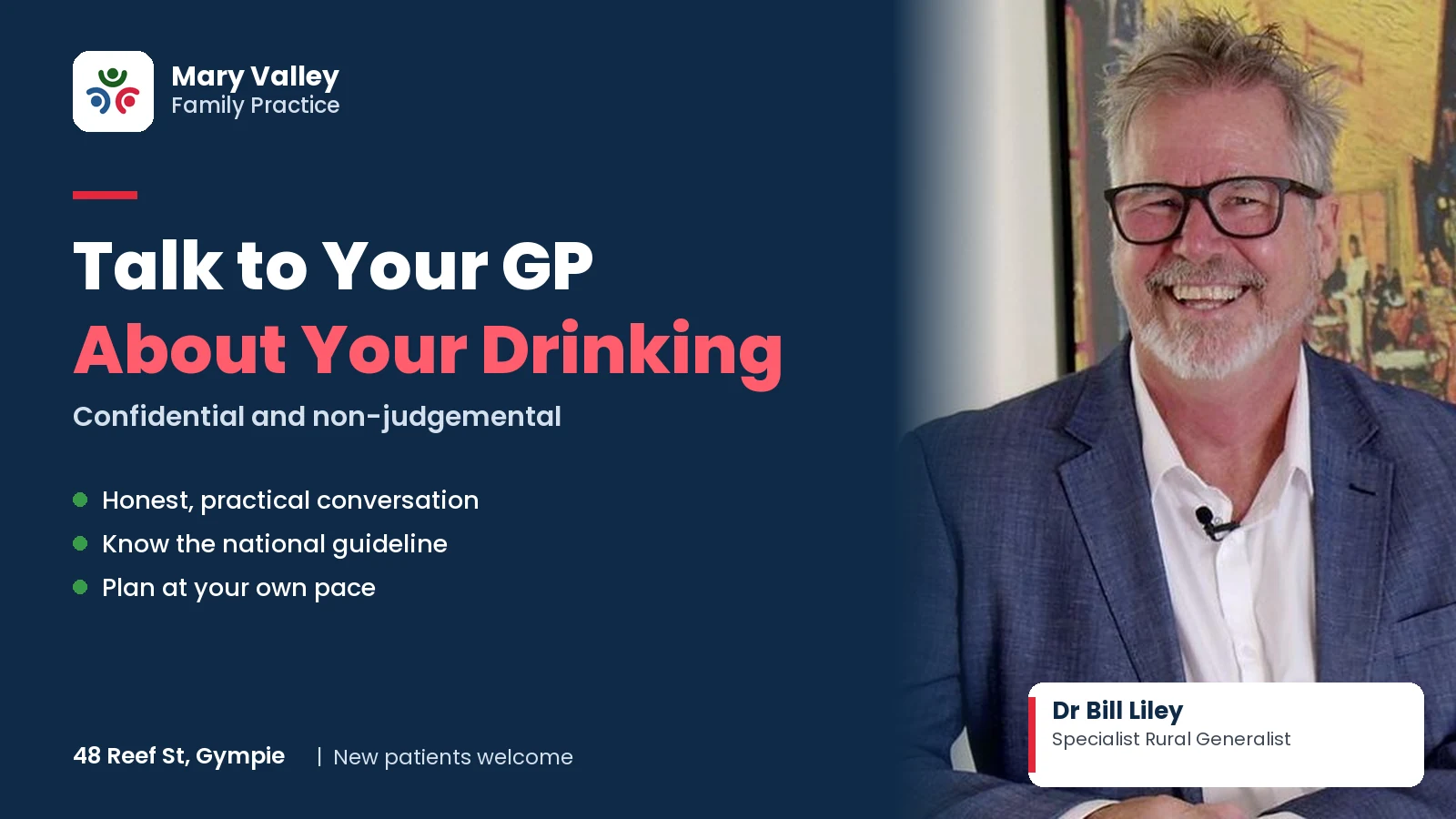
| Quick answer Talking to your GP about drinking is confidential and non-judgemental. Your GP will ask a few questions about how much and how often you drink, check your health and talk through options. The national guideline for healthy adults is no more than 10 standard drinks a week and no more than 4 on any one day. |
Many people worry about raising alcohol with their doctor. If you are wondering how to start, you can talk to your GP about alcohol at any time, and the clinic offers drug and alcohol support in Gympie with a calm, non-judgemental approach. You do not need to have a problem to ask for help.
Why talking to your GP about drinking helps
Alcohol affects many parts of your health, including your heart, liver, sleep, mood and blood pressure. It can also interact with some medicines. A GP can look at the whole picture, not just the number of drinks, and help you decide what would make the biggest difference for you.
You may want to talk to your GP if you:
- Drink more than you intended, or find it hard to cut down
- Feel you need a drink to cope with stress, sleep or worry
- Have been told by family or friends that your drinking is a concern
- Have noticed memory lapses, mood changes or health problems linked to alcohol
- Want to reduce or stop drinking and would like support
How much is too much? The Australian guideline
The NHMRC Australian guidelines to reduce health risks from drinking alcohol are a useful starting point. One standard drink contains about 10 grams of alcohol, and the amount in a glass depends on its size and strength. You can read the guideline on the NHMRC website.
| Group | What the guideline says |
|---|---|
| Healthy adults | No more than 10 standard drinks a week, and no more than 4 on any one day, to reduce lifetime risk |
| Not drinking at all | The lowest risk option for your health, and the only option for some people, such as pregnant women |
| Children and teenagers | Under 18, the safest choice is not to drink alcohol |
| Some medicines or health conditions | Your GP can tell you whether alcohol is safe for you |
These are general limits for adults. Your GP can tell you what they mean for you, especially if you take medicines, have a health condition or are planning a pregnancy.
What to expect when you raise it with your GP
An appointment about alcohol usually feels like a conversation. Your GP will usually:
- Ask about your drinking, including how many drinks you have on a typical day and in a week.
- Use a short, standard questionnaire to understand your pattern of use, if that helps.
- Check your general health, such as blood pressure, mood, sleep and any blood tests needed.
- Talk through your goals, whether that is cutting down, taking a break or stopping completely.
- Agree on a plan with clear next steps and a follow up date that suits you.
You are in control of the conversation. You can say what you are comfortable sharing, and you can ask your GP to explain anything that is unclear.
Alcohol, sleep, mood and everyday life
Alcohol can seem to help at the end of a stressful day, but it often makes sleep lighter and less restful. Over time, many people find that their mood dips the day after drinking, or that worry feels stronger. Because of this, it can be hard to tell whether low mood is causing the drinking or the drinking is adding to the low mood. Your GP can help you untangle the two, and can check for other causes such as stress, pain or a sleep problem.
Alcohol can also affect your daily life in less obvious ways. You might notice that you are more tired at work, that you put off tasks, or that your relationships feel strained. It is worth mentioning these changes to your GP, even if the drinking does not feel like a crisis to you.
Practical steps to cut down
Many people find that small, steady changes help more than a sudden stop. Some ideas to talk about with your GP:
- Set alcohol-free days each week, and keep to them.
- Track your drinks for a week so you can see your real pattern.
- Choose smaller drinks or lower strength options, and drink water between drinks.
- Plan ahead for situations where you usually drink, such as social events or after work.
- Ask for support from a friend, family member or a support group.
In an emergency, call 000. For health advice any time, call healthdirect on 1800 022 222.
Support options that may help
Your GP can connect you with the right support for your situation. Depending on your needs, this may include counselling, a referral to a specialist service, or support to cut down or stop. For someone to talk to any time, Lifeline is available on 13 11 14. If you are worried about someone else’s drinking, your GP can also help you think through next steps.
Talking about alcohol at Mary Valley Family Practice
Our GPs at 48 Reef St, Gympie take a non-judgemental approach. The aim is to support your health and help you reach the goals you set. You can read more about Meet Our Gympie GPs on our team page.
If you would like to talk, you can book a GP appointment in Gympie online. You can also bring a list of the drinks you have in a typical week, which makes the first conversation easier.
Related guides: Signs of ADHD in Adults: When to Talk to Your GP and Meet Our Gympie GPs.
Frequently asked questions
Will my GP judge me for how much I drink?
No. GPs talk about alcohol every day, and the goal is to understand your situation and help. Your GP will treat the conversation as private, and you decide how much to share and what you want to change.
Do I have to stop drinking completely?
Not always. Some people choose to cut down, while others decide to stop completely. Your GP can help you pick a goal that is realistic and safe for you, and can explain the risks of each option.
What counts as a standard drink?
A standard drink contains about 10 grams of alcohol. A full-strength beer, a glass of wine and a nip of spirits can all contain different amounts, so check the label or ask your GP to help you work out your usual intake.
Can my GP help if I am worried about a family member?
Yes. Your GP can talk through how to raise the topic, what support is available and where to go for help. The person you are worried about can also book their own appointment.
Sources
- NHMRC: Australian Guidelines to Reduce Health Risks from Drinking Alcohol
- Healthdirect: Alcohol
- Healthdirect Australia
This article is general information, not medical advice.
Book an appointment with our friendly team.