| Emergency or urgent concern: If a spot is bleeding, crusting, growing quickly or painful, see a doctor promptly. In an emergency, call 000. For health advice any time, call healthdirect on 1800 022 222. |
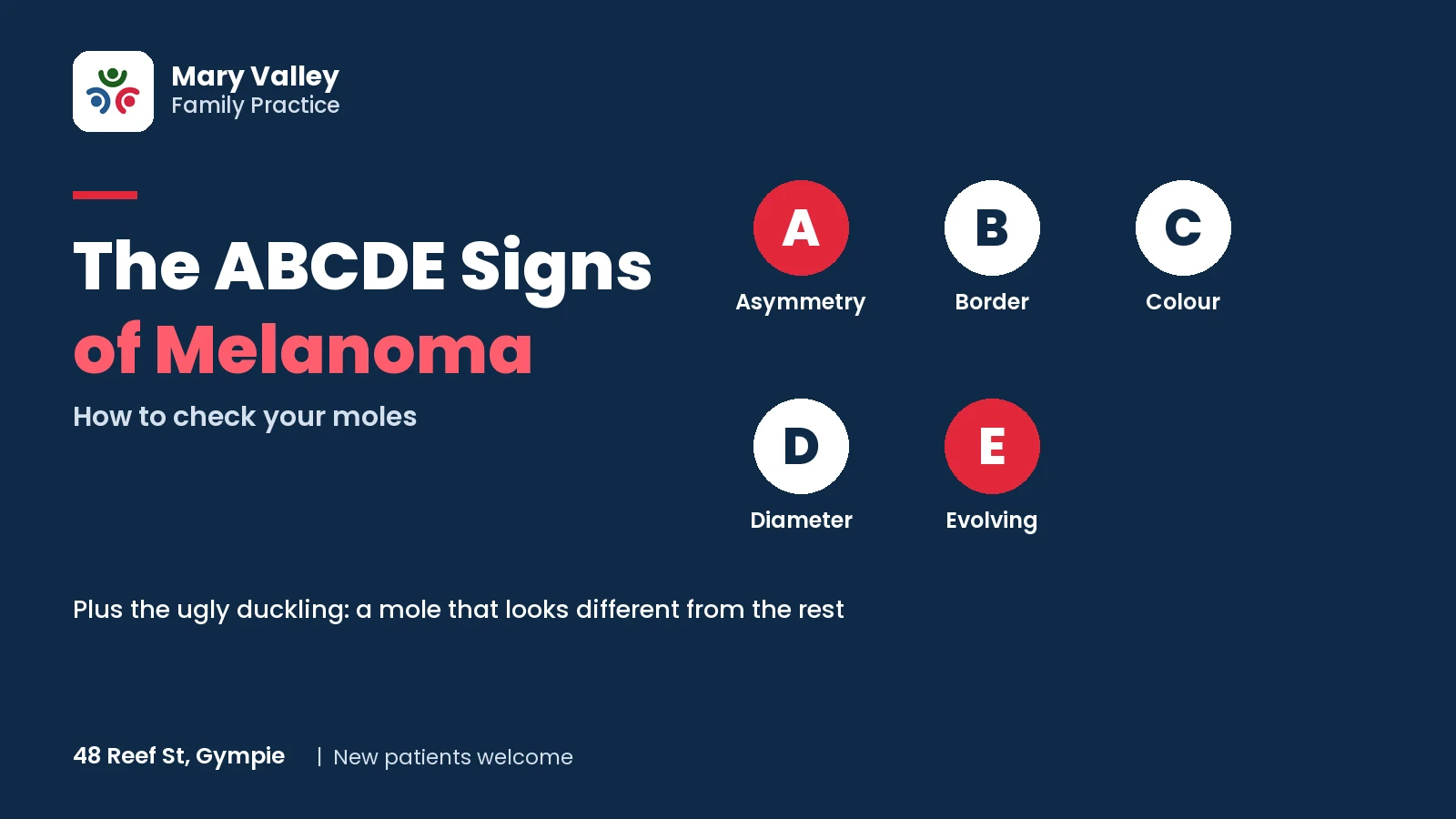
| Quick answer The ABCDE checklist helps you spot the warning signs of melanoma: Asymmetry, Border, Colour, Diameter and Evolving. Also look for the “ugly duckling”, a mole that looks different from the others on your body. Any spot that matches these signs, or is changing, needs to be checked by a GP. Most spots are harmless, but a GP can tell the difference. |
Melanoma is one of the more serious types of skin cancer, but it is very treatable when it is found early. Most people will not know a spot is changing unless they look for it. Checking your skin regularly, and knowing the ABCDE signs, is a simple habit that can make a real difference. If you want a professional look, you can also book a skin check in Gympie at our practice.
The ABCDE signs of melanoma
| Letter | What to look for |
|---|---|
| A: Asymmetry | One half of the spot does not match the other half in shape or colour. |
| B: Border | The edges are uneven, notched, scalloped or blurred, rather than smooth and regular. |
| C: Colour | The spot has more than one colour, or patches of different shades of brown, black, red, white or blue. |
| D: Diameter | The spot is larger than about 6 mm across (roughly the size of a pencil eraser), or is smaller but growing. |
| E: Evolving | The spot has changed in size, shape, colour or surface over time, or has started to itch, bleed or crust. |
A spot does not need to show every sign to be checked. One clear change is enough reason to book a visit.
The ugly duckling sign
Most people have a number of moles, and they tend to look alike. The ugly duckling sign is the idea that a mole that looks clearly different from the rest on the same person deserves a check. It does not automatically mean melanoma, but it is a good reason to show it to a doctor. Look at your back, legs and other areas you cannot see easily, and ask someone you trust to help.
How to check your moles at home
- Check your whole body once a month, in good light, with a mirror for hard-to-see areas.
- Start at the head and neck, then check the arms, hands, chest, back, legs and feet, including between the toes and under the nails.
- Take a photo of any spot you are watching, with a ruler or coin for scale, so you can compare it later.
- Write down the date you first noticed a change, and any new itching, bleeding or crusting.
When to see a GP
See a GP as soon as you can if you notice any of these:
- A spot that matches any letter of the ABCDE checklist, or has changed
- A new spot that looks different from your other moles
- A spot that bleeds, crusts, does not heal or keeps itching
- A spot that someone else has noticed and asked you to check
If a doctor has looked at a spot before and said it was harmless, go back if it changes. A change in shape, size, colour or feel is always worth another check.
What happens at a skin check
At a skin check, the GP looks at the spots you are concerned about and the rest of your skin. Your GP will ask about your history, your sun exposure and any changes you have noticed. If a spot needs closer examination, the GP can talk through the options, which may include a biopsy or referral. Not every spot needs treatment, and your GP will explain what they find.
Related guides: how often should you get a skin check, our GP services in Gympie.
Why finding it early matters
Melanoma starts in the cells that give your skin its colour. When it is found while it is still thin and close to the surface, treatment is usually simpler and the outlook is generally better. Once it has grown deeper or spread, treatment becomes more complicated. That is why a spot that is changing deserves attention early, even when it looks small.
Queensland has high sun exposure all year round, and many people spend time outdoors for work, sport and family life. This makes regular checks more important here than in many other parts of the country. You do not need special equipment to start. A good light, a mirror and a few minutes each month are enough for most people.
Spots that are easy to miss
Many people look at the front of their body and forget the rest. Some melanomas appear in places that are easy to overlook, so take a few extra minutes to check these areas:
- The scalp, behind the ears and the back of the neck, where a partner or hairdresser may be the first to notice a spot
- The soles of the feet, between the toes and under the toenails
- Under the fingernails and toenails, where a dark line that grows or changes should always be checked
- The palms, the groin and the buttocks, which are often missed in self-checks
A dark line under a nail is not always melanoma, but it should be checked by a doctor, especially if it is growing, if it is only on one nail, or if the skin around it is changing.
Protect your skin every day
Checking your skin works best alongside good sun protection. Cancer Council recommends a simple routine that you can use on days when the UV index is three or higher, which is most days in Queensland. Slip on sun-protective clothing, slop on broad-spectrum SPF 30+ sunscreen, slap on a hat, seek shade and slide on sunglasses.
Sunburn is a sign of harm to the skin, even when it is mild. Avoid sunbeds, which increase skin cancer risk. If you have had a lot of sun exposure or sunburn in the past, or you have a family history of melanoma, tell your GP. They can advise how often you should be checked.
Frequently asked questions
Is every mole with an irregular edge melanoma?
No. Many moles have an irregular edge or uneven colour and are harmless. The signs are a prompt for a check, not a diagnosis. Only a doctor can tell what a spot is.
Can melanoma appear on skin that is not sun-exposed?
Yes. Melanoma can appear on areas that are rarely in the sun, including the feet, between the toes, under the nails and on the scalp. Check these areas too.
Do I need a mole map?
A mole map or photo record can help a GP track changes over time, especially if you have many moles. Ask your GP whether it is suitable for you.
Does a painless spot mean it is safe?
No. Melanoma is often painless in its early stages. A spot can be worth checking even if it does not hurt or itch.
General information only. This article does not replace advice from a doctor. In an emergency, call 000.
Sources: Cancer Council Australia, how to check for melanoma (ABCDE checklist, cancer.org.au); healthdirect, melanoma and skin checks (healthdirect.gov.au). Medical reviewer to check the sources and wording against the current Melanoma Institute Australia guidance before publishing.
Book an appointment with our friendly team.